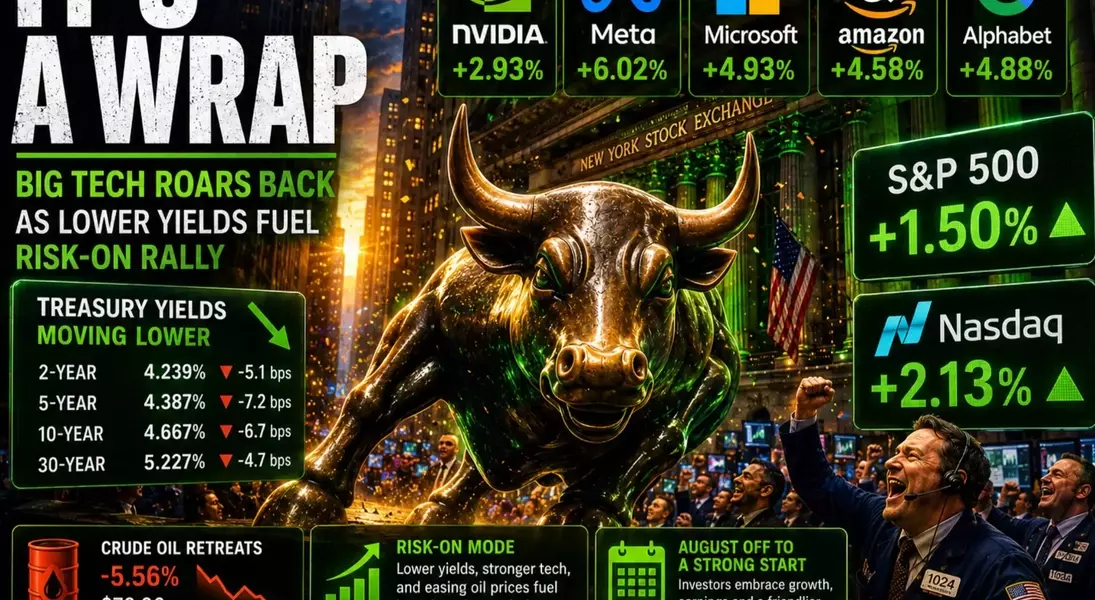
The beginning of August witnessed a significant upswing in U.S. equities, as market participants demonstrated a renewed willingness to take on risk. This positive momentum was fueled by several key economic indicators and market trends, including a surprisingly strong ISM Manufacturing report, which signaled expansion in the factory sector and a notable increase in hiring. Alongside this, a decline in Treasury yields and a drop in oil prices provided further impetus, contributing to a broad rally that saw technology giants leading the charge.
Despite underlying concerns about persistent inflationary pressures within the manufacturing sector and lingering geopolitical tensions, investors chose to focus on the encouraging data. The Federal Reserve's stance on monetary policy, articulated by New York Fed President John Williams, also played a role in stabilizing market sentiment, as he reiterated confidence in the current interest rate trajectory to manage inflation without immediate shifts. This combination of factors created an environment conducive to growth, particularly benefiting those sectors poised for rapid innovation and expansion.
Market Rally Driven by Robust Manufacturing and Tech Surge
U.S. equities experienced a strong start to August, marked by a significant shift towards risk-on sentiment across Wall Street. This rally was largely underpinned by an encouraging ISM Manufacturing report, which exceeded market expectations. The manufacturing index climbed to 55.6, surpassing the consensus forecast of 54.0 and June's reading of 53.3, marking its most robust performance in over four years. A critical component of this positive report was the Employment Index, which surged to 52.8 from 49.7, indicating a return to expansion for the first time in 33 months and reaching its highest level since August 2022. This strong manufacturing data, coupled with a notable decline in Treasury yields and oil prices, created a favorable environment that bolstered investor confidence and drove a broad market advance.
The positive economic data was further reinforced by significant gains in the technology sector, with major large-cap tech companies experiencing substantial increases. This renewed investor interest in technology, often seen as a bellwether for market confidence, contributed significantly to the overall bullish tone. Falling bond yields eased valuation pressures on growth stocks, making these high-potential companies more attractive to investors. Simultaneously, a sharp drop in WTI crude oil prices to below per barrel alleviated concerns about immediate inflationary pressures, further supporting the risk-on attitude. These combined elements—strong manufacturing expansion, improved employment figures, reduced commodity prices, and a resurgent tech sector—provided a compelling narrative for the market's upward trajectory at the start of the month.
Federal Reserve's Stance and Foreign Exchange Dynamics
New York Fed President John Williams offered insights into the Federal Reserve's current monetary policy, stating that the July interest rate decisions were "well positioned" to guide inflation back to the central bank's 2% target. His comments reinforced the Fed's dedication to price stability and indicated that future policy adjustments would be data-dependent, offering no immediate signals of a shift. Williams also acknowledged the ongoing geopolitical uncertainties, particularly those related to the Middle East, but expressed optimism that any resulting inflationary impacts would likely be temporary. This communication aimed to temper market volatility and provide clarity on the central bank's long-term strategy, ensuring that market expectations align with the Fed's objectives without dictating policy decisions.
In the foreign exchange markets, the U.S. dollar generally strengthened against most major currencies, reflecting global financial shifts and domestic economic indicators. The greenback posted gains against the Australian dollar, New Zealand dollar, British pound, Swiss franc, and the euro. The notable exception was the Japanese yen, which saw the dollar decline by 0.28%, making it the strongest performing major currency during this period. This performance highlights the complex interplay of global economic conditions, investor sentiment, and central bank communications in shaping currency valuations. The overall market reaction to economic data and policy statements underscored a period of cautious optimism, with investors closely monitoring future reports for further direction.